
How to Properly Prepare Roll Labels: Winding Direction
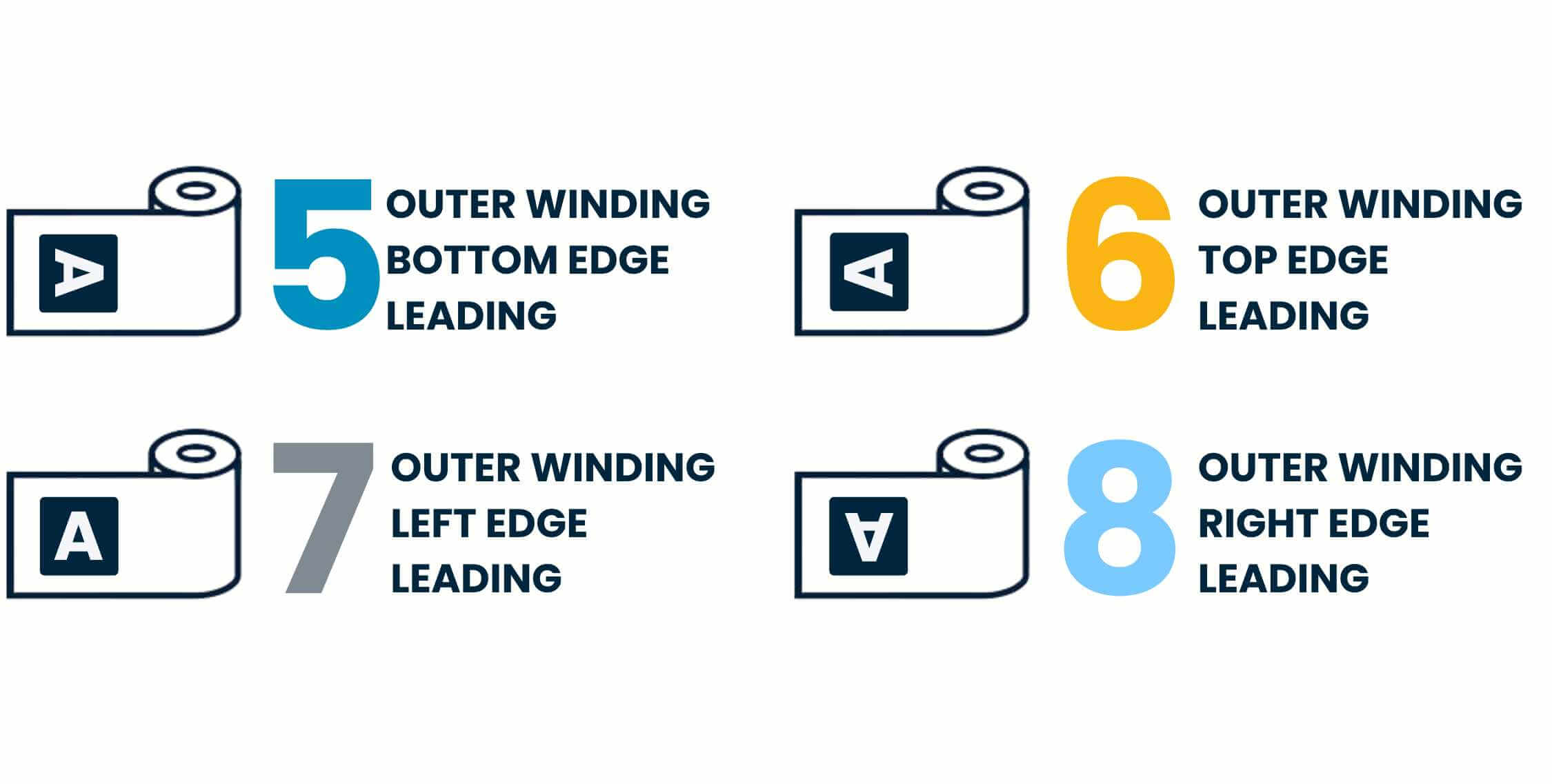
If you plan to apply your roll labels using a labelling machine, it is important to select the correct winding direction for your application.
There are two basic winding options for roll labels:
#1 Inner winding (Inside)
#2 Outer winding (Outside)
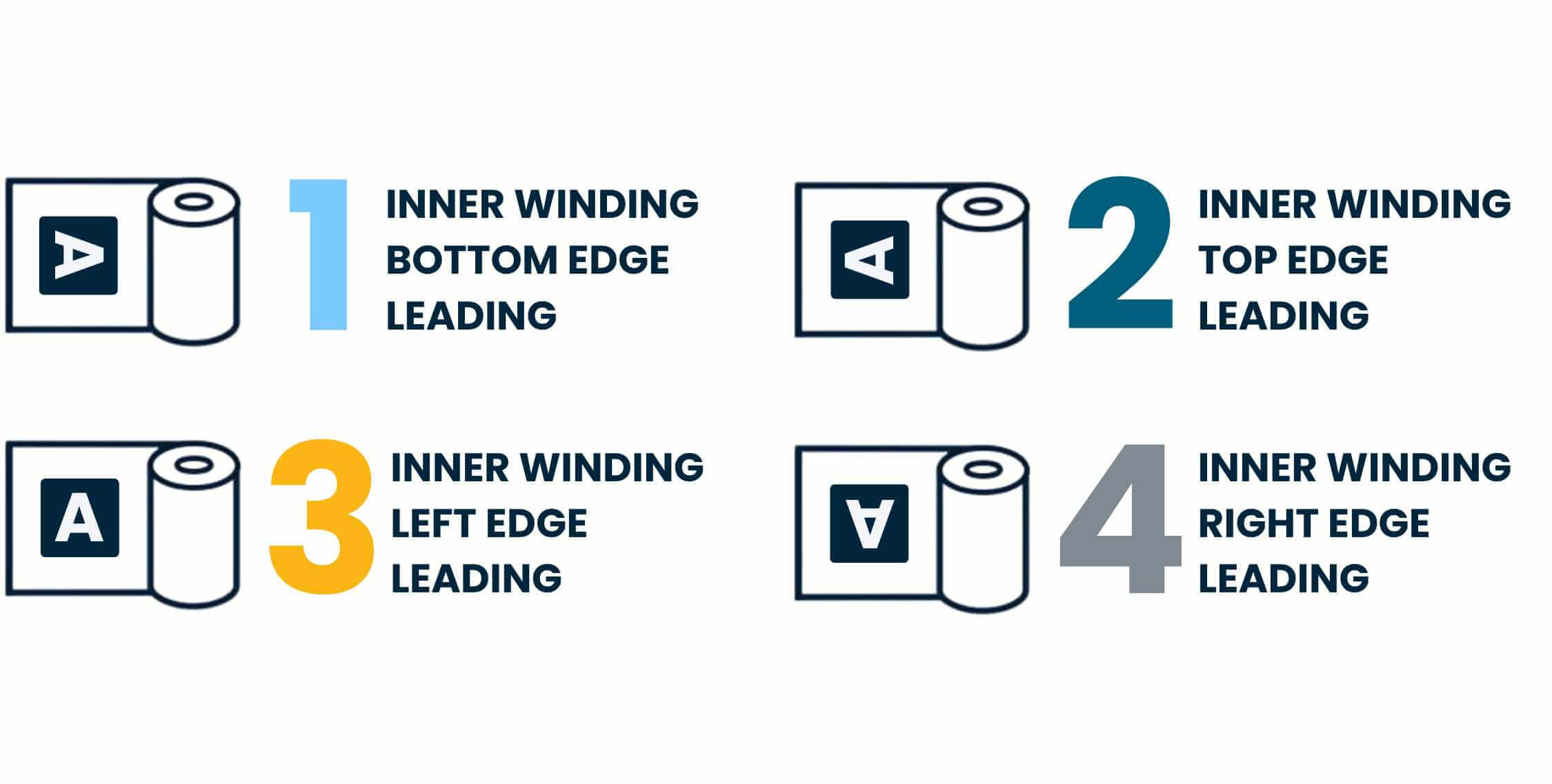
In addition to the winding type, the orientation of the labels on the roll must also be specified. There are four standard options:
#1 Bottom Edge Leading
#2 Top Edge Leading
#3 Left Edge Leading
#4 Right Edge Leading
If you’re unsure which winding direction you need for your labels, simply contact our customer service. You can reach us Monday through Friday from 8:00 a.m. to 5:00 p.m. by phone at 06502 / 984940 or by email at info@etikett.de. We’re happy to help!
Other Terms Related to Roll Label Manufacturing
Labels on rolls are usually processed further by machine, meaning they are applied to the product automatically. In the production of roll labels, it is therefore very important to understand the requirements of the processing machine and to manufacture the label rolls accordingly. The following specifications should be taken into account:

Outer Diameter
The maximum outer diameter you can order using the calculator is 350 mm. Larger diameters can also be produced upon request.
In addition, you can choose either the size of the label roll or the number of labels per roll. The maximum roll size is important to ensure that the roll fits easily into your labeling machine during automated processing. If no specifications are provided, the rolls will be manufactured based on environmental and economic considerations.
Core diameter
The standard core diameter is 76 mm (inner diameter), but we also offer 40 mm and 25 mm ones.
The correct core size is extremely important, especially for machine processing. This specification depends on the requirements of your processing machine. When applying labels by hand, this specification is not a concern.
Label Height & Width
It is important that you specify the final size of the label here—that is, without bleed. The width and height are defined based on the label view/layout—that is, how the label will be positioned on the product later.
Here’s an example: If you need die-cut labels measuring 50 x 100 mm (W x H), please enter these dimensions into the calculator.
Gap
The term “gap” refers to the distance between two labels on the roll. This spacing varies from customer to customer, depending on how the labels are further processed and applied to the product.
By default, we produce labels with a 5-mm gap between them on the roll. A smaller gap is available upon request. However, we recommend a minimum gap of 3 mm. Anything less than that would make machine processing and weeding more difficult.
Matrix
The word matrix refers to the distance from the label to the edge of the roll. This applies only to the production of roll labels; when producing A4 sheets, this specification can be disregarded.
The standard is 2.5 mm on both sides, for a total of 5 mm. We recommend a minimum margin of 1.5 mm on both sides, for a total of 3 mm. Wider bleeds are available upon request. Falling below the minimum value may cause difficulties during weeding.
What’s next for your labels?
If you’re not yet sure which materials you’d like to use for your roll labels, order our free sample book. There you’ll find an overview of our standard materials, including pre-cut sample labels that you can try out on your products.
If you already know what you need, you can easily calculate the cost of your labels online using our calculator. If you like the quote, you can either have it sent to you by email or order it directly online.
If you have any questions, just send us a message using the contact form.